
Table of Contents
Sliding Gate vs Swing Gate Openers: How the Two Systems Differ
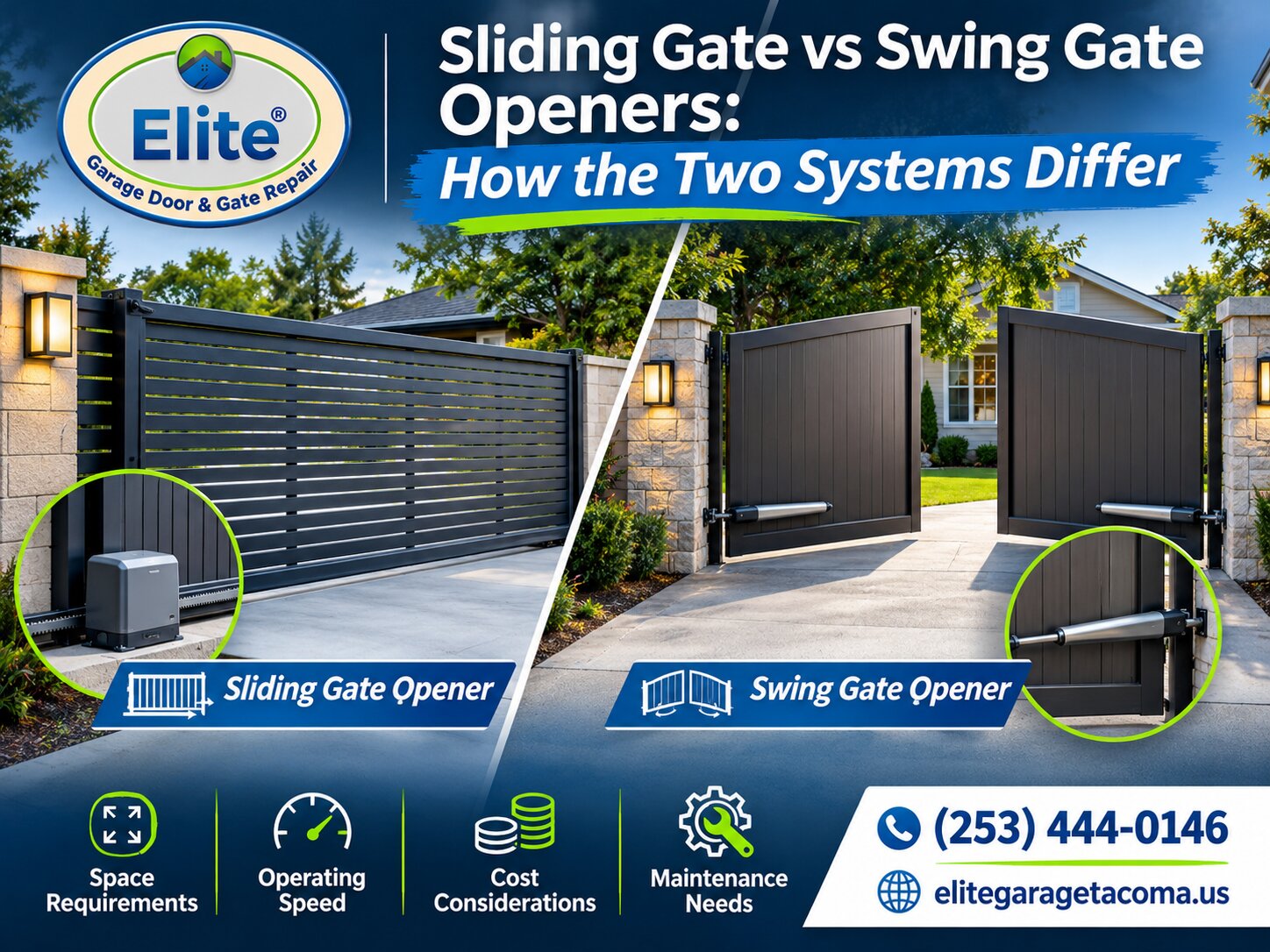
The question of sliding vs swing gate openers comes down to how each gate moves and how much room the property allows for that motion. A sliding gate operator drives the gate along a track or rail so the gate glides to one side, parallel to the fence line. A swing gate operator uses an arm or actuator that pushes or pulls a hinged gate open, much like a door swinging on a frame.
Both systems are common choices among driveway gate openers, and neither is a universal answer. The right pick depends on the slope of the driveway, the weight of the gate, and the space available around the entrance.
How does a sliding gate operator work?
A sliding gate operator uses a motor connected to a gear rack or chain mounted along the gate. As the motor turns, the gate rolls along a track set into or alongside the driveway. The gate itself stays in one plane and does not swing into the yard or the street.
This design calls for open fence line beside the driveway equal to roughly the width of the gate, since the gate needs somewhere to travel once it opens. A sliding gate also tends to suit uneven or sloped driveways better than a hinged gate, since it does not need to clear the ground as it moves.
How does a swing gate operator work?
A swing gate operator attaches an arm or linear actuator between the gate post and the gate panel. When activated, the arm extends or retracts to push the gate open or pull it closed, pivoting on its hinges. Swing gates can open inward toward the property or outward toward the street, depending on how the hinges are set.
This system needs clear space in front of or behind the gate so the panel has room to swing without striking a vehicle, a wall, or a slope in the driveway. A swing gate on uneven ground may drag or bind if the arc of the gate does not clear the surface evenly.
Weight, ground, and space: what shapes the choice
The weight of the gate affects both systems but in different ways. A heavier gate on a track still rolls along a level path, while a heavier swing gate places more strain on the hinge posts and the arm that pushes it. Ground conditions matter just as much: a sliding gate relies on a firm, level track bed, while a swing gate depends on solid, well set posts able to carry the full weight of the panel as it pivots.
Space is often the deciding factor. A property with a long, open fence line can usually accommodate a sliding gate, while a property with limited side space but open room in front of the entrance may suit a swing gate instead.
What to ask a technician
A trained technician can walk the driveway and point out which gate operator types fit the available space and the slope of the ground. Bring specific questions about the gate’s weight, the condition of the posts, and how the driveway surface might affect either a track or a swing arc.
Gate operators and garage door openers share some common ground in how a motor and drive mechanism move a heavy panel. For background on choosing a system for a garage, see Garage Door Openers, and for parts that keep a drive mechanism running smoothly, see Garage Door Parts.
For a closer look at how to weigh features before deciding on a system, read this post on choosing a garage door opener. For notes on keeping an opener running when the power goes out, see this post on battery backup for openers.